
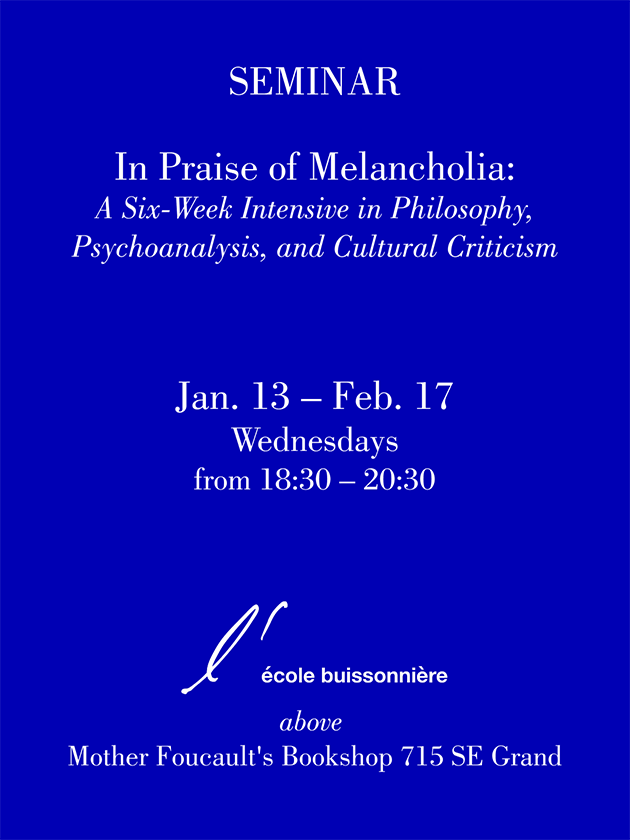
In Praise of Melancholia is a six-week philosophy intensive exploring melancholy not simply as a feeling to overcome, but as a philosophical, psychoanalytic, literary, and cultural tradition for thinking about loss, longing, desire, creativity, and our relationship to the world.
Drawing from thinkers including Sigmund Freud, Julia Kristeva, and contemporary critics of productivity and compulsory happiness, the course combines focused lectures with close readings of selected texts, art and cultural examples, guided discussion, and thought experiments. Prior academic experience in philosophy is not required, but participants should come prepared to engage seriously with challenging ideas and texts. The aim is not to simplify philosophy into self-help, but to create an intellectually rigorous space in which people outside the academy can encounter difficult ideas together.
The Radical Premise
The radical element of this course lies in its refusal to begin from the assumption that melancholy is necessarily a problem to be solved.
Contemporary culture often treats difficult emotional states as obstacles to happiness, wellness, productivity, or self-improvement. In Praise of Melancholia instead asks what might be lost when we demand that grief, sadness, longing, or dissatisfaction become productive—or disappear altogether.
Rather than romanticizing suffering, the course asks whether melancholy can sometimes preserve something important: an attachment, a memory, a refusal, a form of knowledge, or even a way of resisting demands to continually recover, improve, and move on.
Participants will leave not with a prescription for overcoming melancholy, but with a richer philosophical vocabulary for thinking about what melancholy is, what it has meant historically, and what uses it might still have.
Learning Outcomes
By the end of the six weeks, participants will be able to:
Identify major philosophical, psychoanalytic, and cultural approaches to melancholia and explain how the concept has changed across historical contexts.
Engage closely with challenging primary and theoretical texts, including works by Freud and Kristeva.
Distinguish melancholia from related concepts such as mourning, grief, sadness, and depression, while considering the historical and cultural forces that shape these distinctions.
Analyze representations of melancholia in literature, art, film, and everyday life using the philosophical concepts introduced in the course.
Critically examine contemporary assumptions about happiness, wellness, productivity, recovery, and the expectation that difficult emotional states should be overcome.
Develop and articulate an independent response to the central question:
Can melancholia have a use?

Kellye McBride
About the Instructor
Kellye McBride holds an MA in Contemporary European Philosophy from Kingston University London, completed through a joint program with Université Paris 8, and a BA in Philosophy with departmental honors from the University of Oregon. She has taught philosophy in university and public-humanities settings, including Chemeketa Community College and Portland's People's Colloquium. Her teaching emphasizes critical engagement with primary texts, lively discussion, and making complex theoretical ideas comprehensible without sacrificing their intellectual depth. Kellye is also a professional editor and writer and the creator of Melancholia, a podcast exploring philosophical, psychoanalytic, literary, and cultural approaches to melancholy. Her interests include Continental philosophy, critical theory, psychoanalysis, death, desire, and the relationship between intellectual inquiry and everyday life.
Maximum 20 participants.